
Technical Q&A | Can Reflective Displays Keep Up with Changing Transit Information?
In the transportation sector, Reflective displays (such as e-paper and E Ink) are often used for static signage, leading some clients to develop a stereotype:
“Isn’t the refresh rate of a fully reflective screen very low? Will it lag when updating bus schedules frequently during traffic congestion?”
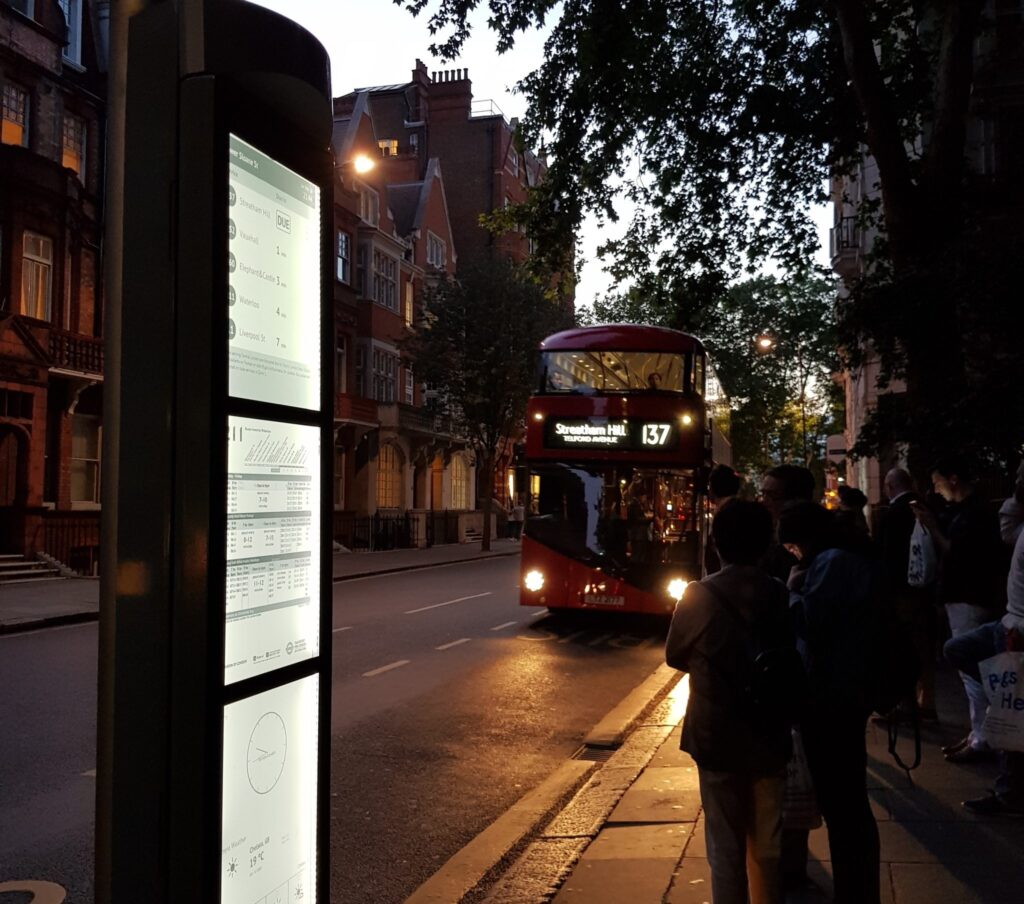
We must clarify this technical misconception: The refresh rate of fully reflective screens is on par with traditional LCD screens, typically maintaining a stable 60Hz.
This means fully reflective screens are entirely consistent with ordinary liquid crystal display devices, capable of smoothly handling dynamic data updates on transit information boards and industrial dashboards. Whether it’s the countdown for a bus arrival or real-time pressure monitoring on an industrial assembly line, a 60Hz refresh rate ensures no ghosting or latency. Furthermore, combined with the ultra-low power consumption of fully reflective technology, our modules help transit signage and industrial sensor terminals achieve battery life lasting several months, perfectly aligning with the green, low-carbon, and maintenance-free requirements of industrial applications.
Why does reflective not mean slow?
“Reflective” describes how a display uses ambient light to produce a visible image. TFT describes how its pixels are controlled. The two can work together: a reflective LCD can use a TFT active-matrix backplane.
Some reflective LCDs support a 60Hz refresh rate, matching the refresh rate of common 60Hz transmissive TFT-LCDs. However, this capability does not apply to every reflective display and should not be assumed for ChLCD or e-paper products.
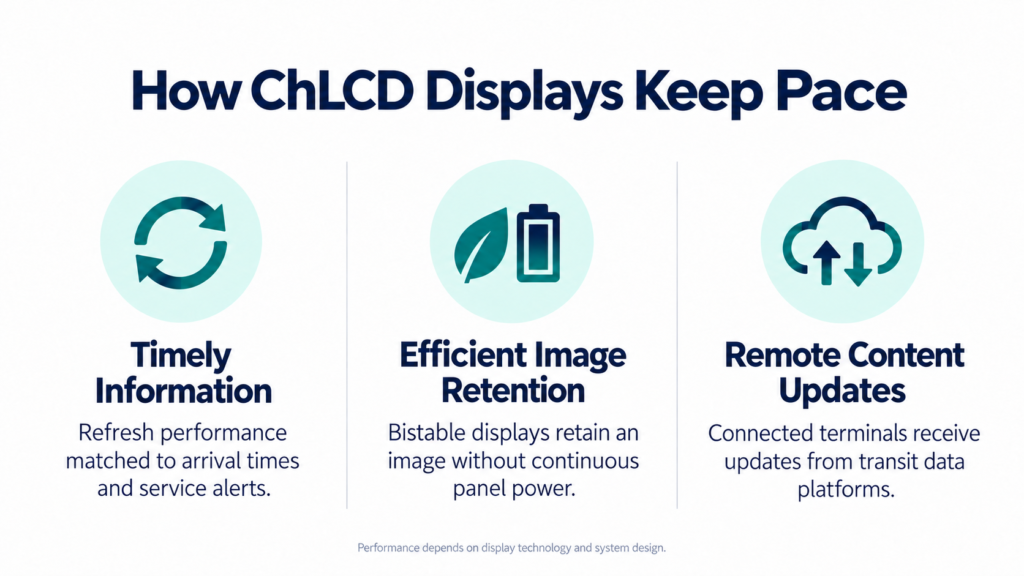
Does transit information require 60Hz?
While they are structurally slower than traditional LCD or LED screens, real-time public transit updates—like bus arrival countdowns, gate changes, and service alerts—do not require rapid video frame rates.
It depends on the content.
Continuous scrolling text, animation, and video require closer attention to both refresh rate and pixel response time. These are different measures: refresh rate describes how often the screen refreshes, while response time describes how quickly pixels change state. A 60Hz specification alone does not guarantee motion free from ghosting under all conditions.
What should be evaluated in a real project?
Testing with actual display content helps establish three requirements:
- Update timing: How often does the content change, and what delay is acceptable?
- Visual performance: Does updating cause flashing, residual images, or a temporary loss of readability?
- Operating conditions: Can the display update reliably at the required temperatures and within the system’s power budget?
Content delivery, network transmission, and terminal processing also affect how quickly new information appears. Performance should therefore be assessed across the complete system.
If you are looking at transit solutions, let us know:
- Are you evaluating signs for indoor or outdoor environments?
- Will the signs have access to grid power, or do they need to be solar/battery-operated?
Techtion Smart team can give you a more tailored recommendation based on those factors.
 Previous Article

 Microsoft Teams
 WhatsApp
 Email
 Inquiry
 WeChat

 TOP