
Why do Techtion Smart’s outdoor display terminals all use full lamination technology?
—Technological Upgrades from Optical Structure and Environmental Reliability to Long-Term Outdoor Applications
I. Why Outdoor Displays Can't Rely Solely on High Brightness?
In modern human-computer interaction devices, touch displays have become an essential component of smartphones, tablets, industrial HMIs, automotive displays, and outdoor smart terminals.
However, for display terminals operating in complex environments for extended periods, display quality depends not only on brightness, resolution, and size. Key factors truly determining product experience and reliability include optical structure, protective design, material weather resistance, and long-term environmental adaptability.
Among these, the bonding method between the touchscreen and the display screen is one of the core technologies affecting display quality and reliability. Currently, the market mainly offers two structures: traditional frame bonding (air gap bonding) and full lamination (full lamination/optical bonding).
For indoor, cost-sensitive devices, frame bonding still has certain advantages. However, for products such as bus stop signs, outdoor information screens, parking lot wayfinding systems, EV charging stations, and self-service terminals that are constantly exposed to sunlight, rain, and temperature fluctuations, full lamination has become a crucial direction for improving product performance.
Techtion Smart, based on the real-world needs of outdoor applications, has adopted full lamination as a key technology for outdoor display terminals.
In outdoor display projects, brightness is usually the primary parameter that customers focus on, such as 1000 nits, 1500 nits, or even 2500 nits.
However, in practical applications, brightness is not equivalent to readability.
The intensity of sunlight in outdoor environments is much higher than indoor lighting, and ambient light shines on the display surface and causes reflection. If the screen has severe internal reflections, ambient light will obscure the displayed content, making black areas appear gray, text edges blurry, and the image lacking depth.
Therefore, the performance of outdoor displays is actually determined by multiple factors:
• Backlight brightness
• Display contrast ratio
• Screen reflectivity
• Optical lamination method
• Cover glass treatment
• Viewing angle
This is why some high-brightness displays, even after being installed outdoors, still experience the problem of being “unreadable in sunlight.”
An excellent outdoor display solution doesn’t simply increase backlight brightness; rather, it optimizes the optical structure to allow more display light to effectively reach the user’s eyes while reducing ambient light interference.
II. The Fundamental Difference Between Frame-Mounted and Fully Laminated Displays: Air Gap and Optical Adhesive Layer
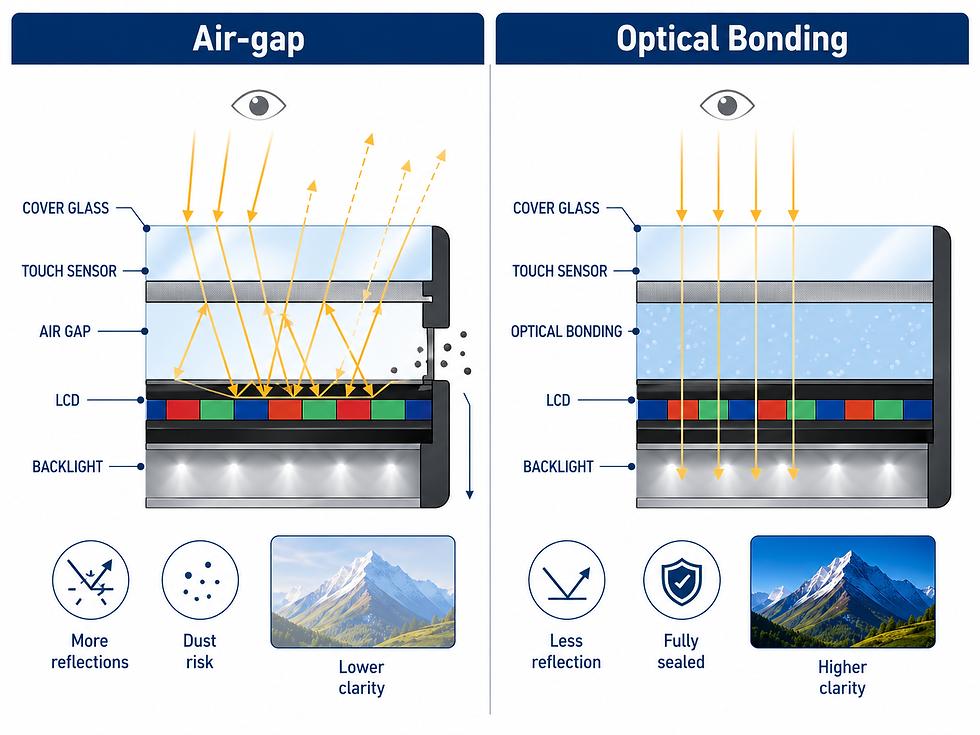
In traditional frame-mount structures, an air gap exists between the touchscreen (CTP) and the LCD display.
The touchscreen is fixed to the display module using double-sided adhesive or sealant, leaving the central area as air.
This structure is simple to manufacture, low in cost, and relatively easy to repair. However, the air gap introduces significant optical problems.
When external light enters the screen, it undergoes multiple reflections and refractions between the glass, air gap, touch layer, and LCD surface.
Due to the difference in refractive index between air and glass/colloidal materials, an air gap increases light reflection loss, leading to:
• A grayish appearance
• Reduced black levels
• Decreased contrast
• Unclear display in bright light
Full lamination technology, however, uses optically transparent materials such as OCA (Optical Clear Adhesive) or OCR (Optical Clear Resin) to seamlessly integrate the cover glass, touch sensor, and LCD display layer.
The air gap is completely eliminated, resulting in a more compact, integrated optical structure for the display module.
III. Core Advantages of Full Lamination
IV. Why does full lamination need to be combined with AR/AG/AF glass?
1. Improved Readability in Sunlight
The greatest value of full lamination lies in reducing internal reflections.
In bright light, a brighter screen is not necessarily better; reducing ineffective light loss is crucial.
By eliminating the air gap, full lamination reduces internal interface reflections, improving image contrast and making text, icons, and images clearer.
For applications such as bus arrival information, airport flight information, parking guidance, and charging interfaces, users typically need to quickly access information; therefore, readability is more important than simply pursuing high brightness.
2. Reduced Impact of Fogging, Dust Ingress, and Moisture Contamination
One of the biggest challenges in outdoor environments is temperature and humidity fluctuation.
For example:
• Sunlight exposure during the day causes internal heating
• Temperature drops at night leading to condensation
• Long-term effects of rainy, high-humidity environments
Air layers in the frame-mount structure can become breeding grounds for moisture and dust, leading to:
• Internal fogging
• Dust spots
• Display malfunctions
Full lamination eliminates the air spaces between display layers, helping to reduce the risk of internal fogging and contamination.
It’s important to note that full lamination requires a combined overall sealing design, IP protection, and waterproof structure to achieve complete outdoor reliability.
3. Enhanced Mechanical Strength and Vibration Resistance
Outdoor display terminals may be subjected to:
• Wind and sun exposure
• Equipment vibration
• Transportation impact
• Human contact
Frame-mount structures are multi-layered and separate; full lamination creates a more stable, integrated structure between the layers.
This improves:
• Impact resistance
• Vibration resistance
• Structural stability
Therefore, full lamination is widely used in transportation, automotive, industrial, and outdoor equipment.
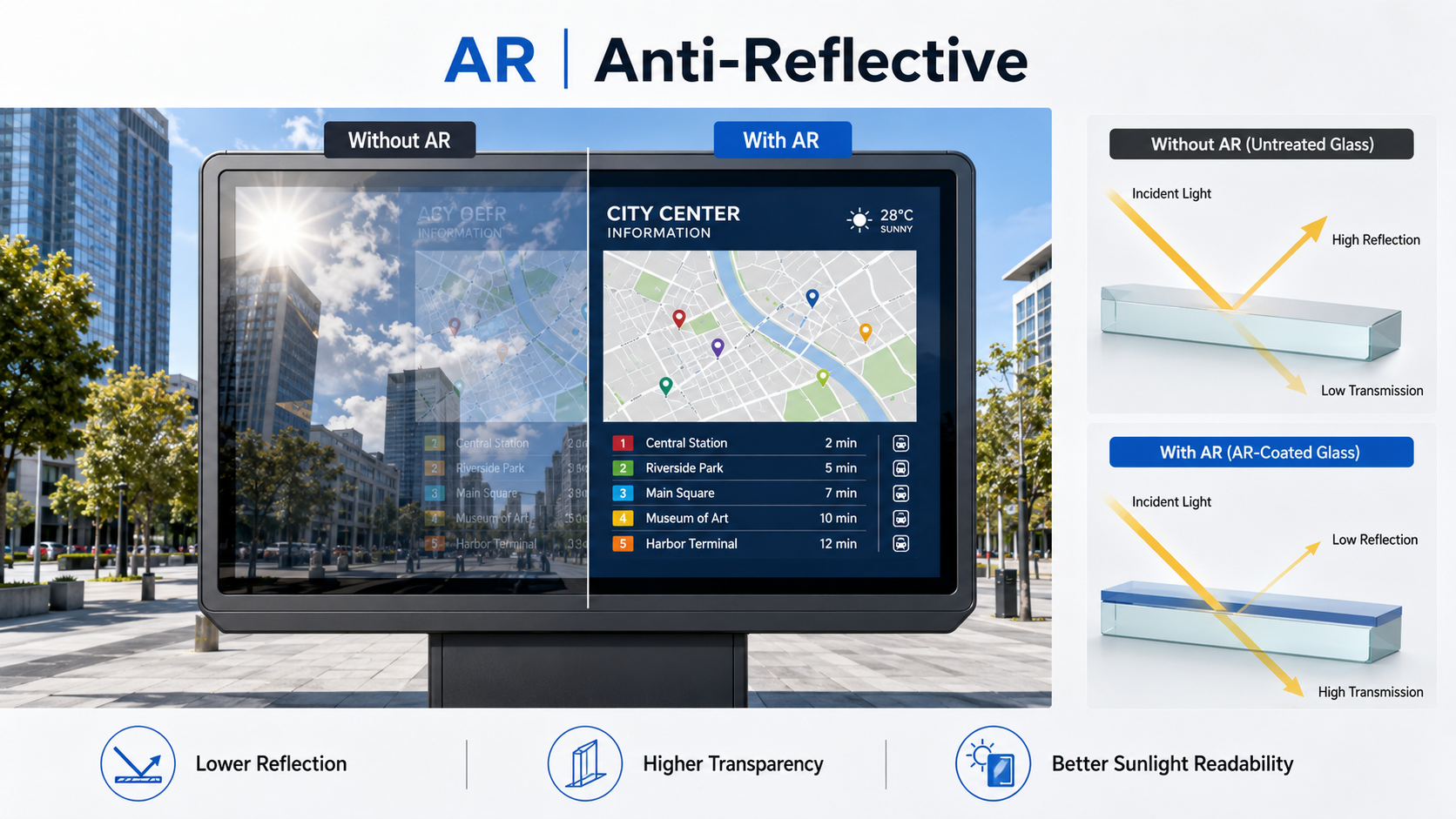
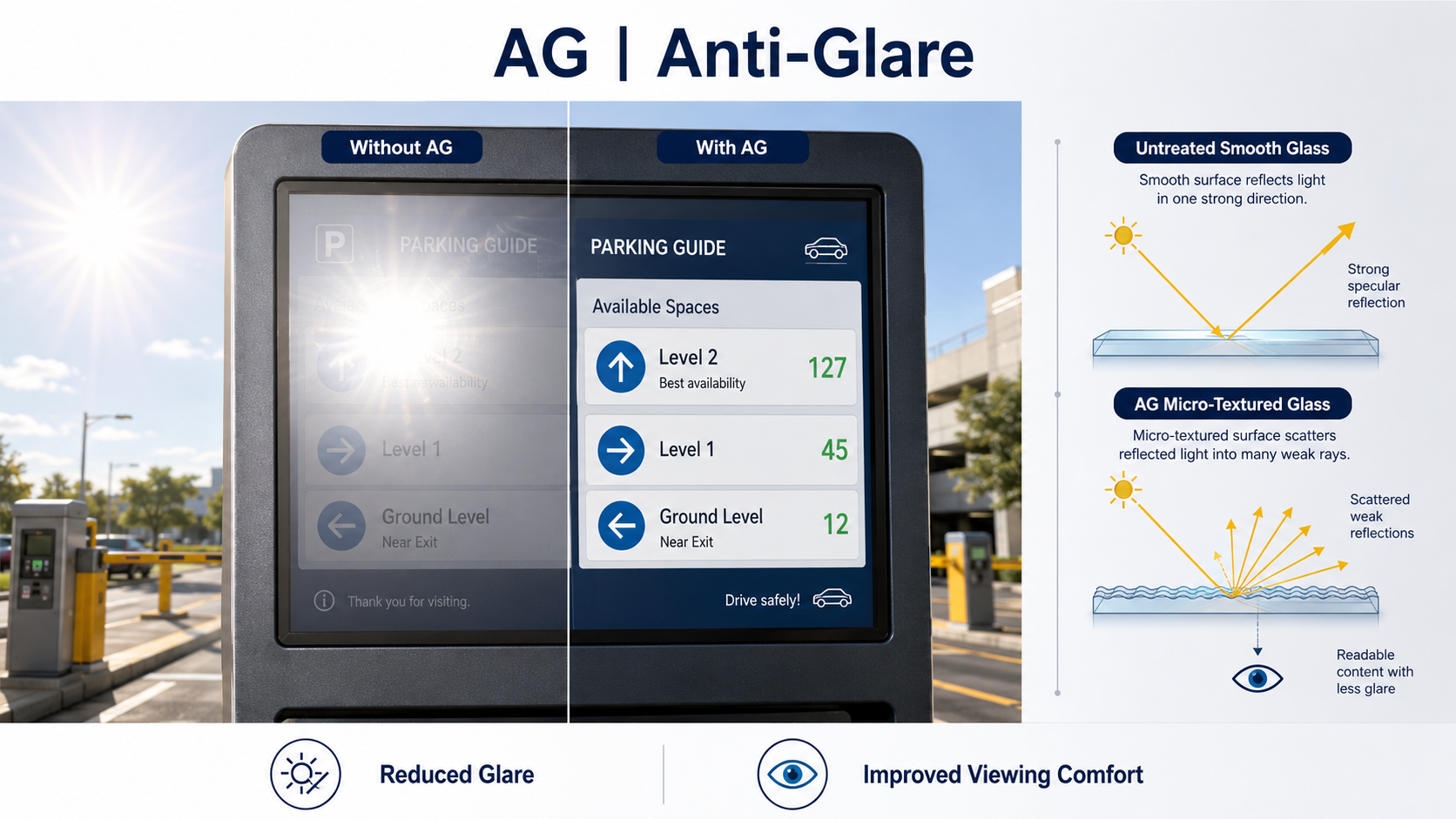
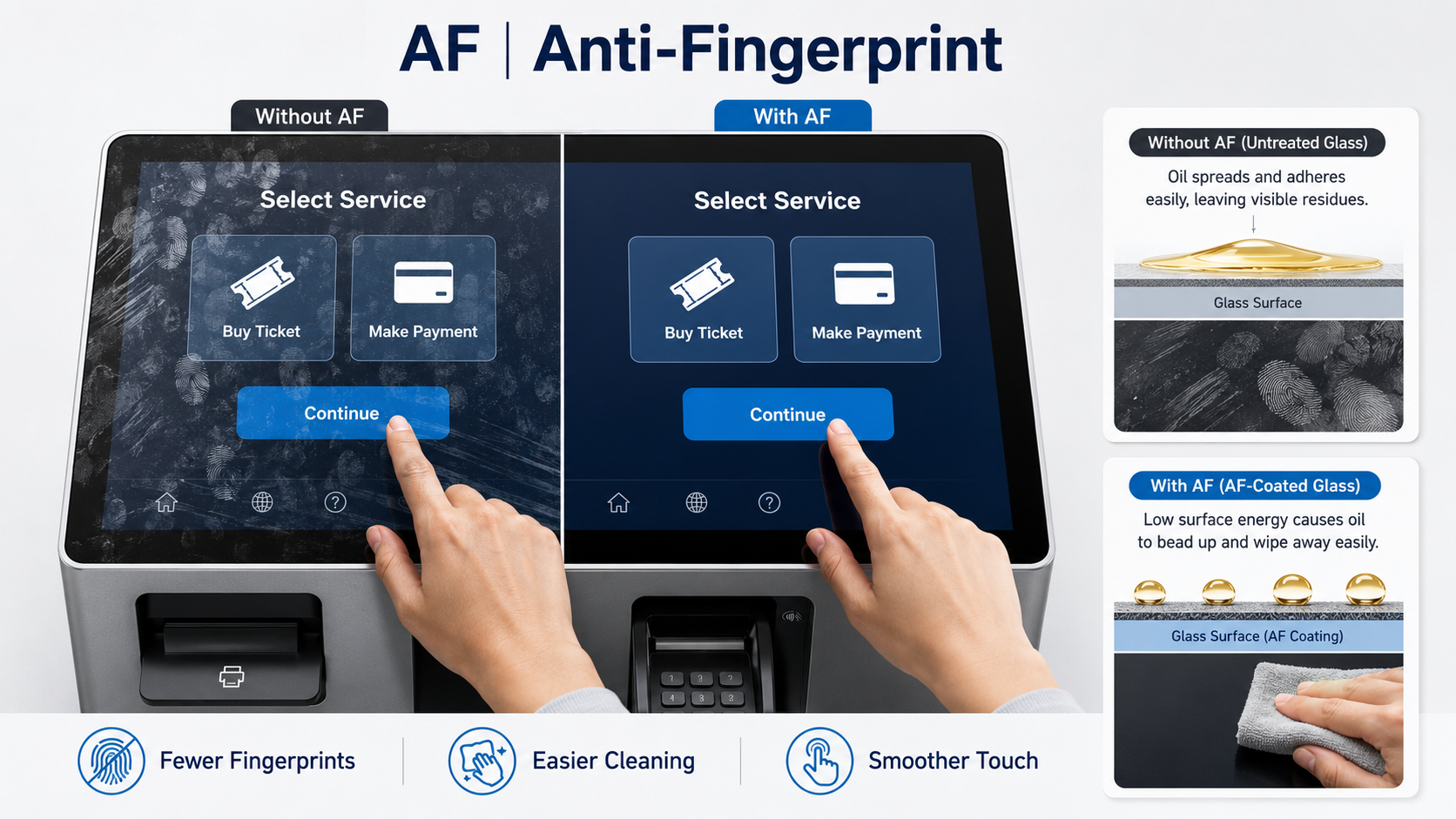
Full lamination primarily addresses internal reflections in the display, while the cover glass surface treatment further optimizes the external optical environment.
AR reduces surface reflectivity and increases light transmittance through a multi-layer optical film structure.
AG scatters strongly reflected light through surface microstructures, reducing glare.
AF improves the long-term user experience of touch devices.
V. Outdoor Display Selection Should Not Be Based Solely on Brightness Parameters
Professional outdoor display terminals require comprehensive evaluation:
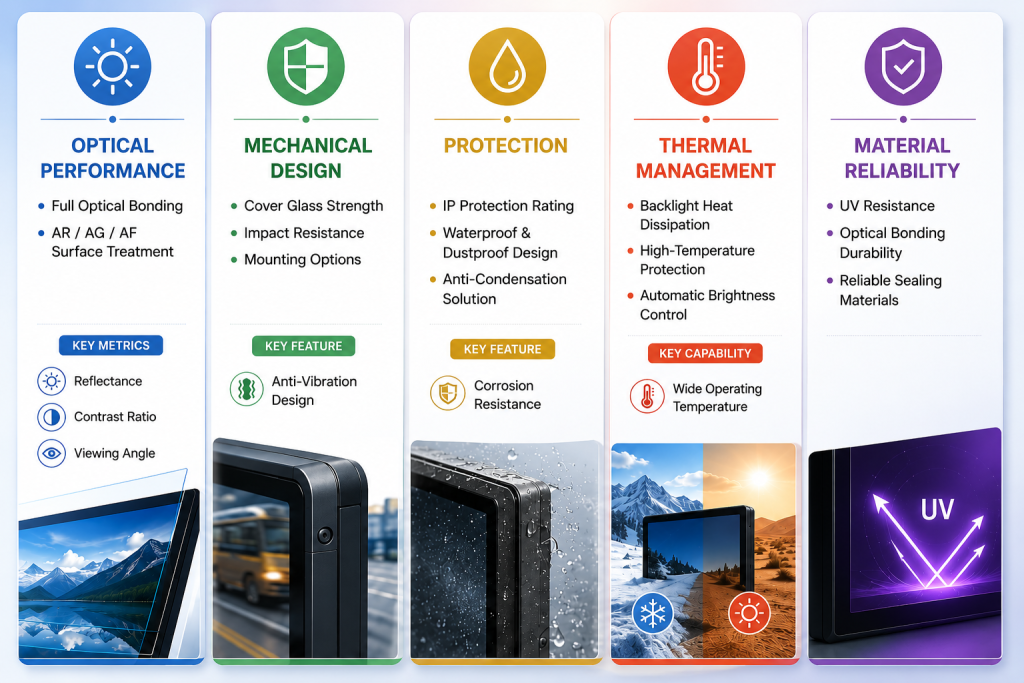
VI. Techtion Smart Outdoor Display Solution: From Single Display to System Reliability Design
For outdoor display terminals, full lamination is not an independent process, but an important component of the overall product reliability design system.
Techtion Smart systematically integrates optics, structure, protection, heat dissipation, and material selection for outdoor applications, enabling the display terminal not only to display normally in the field environment but also to operate stably for a long time.
1. Full Lamination + High Brightness Display: Improving Information Reading Efficiency Under Sunlight
Outdoor applications first require clearly visible display content. Techtion Smart provides sufficient light output through a high-brightness LCD backlight design; at the same time, combined with a full lamination structure to reduce internal reflections, it allows the display light to be transmitted to the user’s eyes more effectively.
This combination avoids the high power consumption, high heat generation, and backlight lifespan pressure caused by simply increasing brightness, achieving a more reasonable outdoor readability design.
2. Full Lamination + AR/AG/AF Glass: Optimizing the Experience in Different Outdoor Scenarios
Different application environments have different requirements for glass surface treatment:
• Bus stop signs, outdoor information screens: Focusing on information readability under direct sunlight, full lamination combined with AG anti-glare design can be used to reduce strong light interference.
• High-end smart city terminals: Requiring better image clarity and visual effects, full lamination combined with AR anti-reflective treatment can be used to improve display clarity and color performance.
• Outdoor touch terminals: For example, self-service ticket machines, charging piles, and query devices require long-term touch operation; AF anti-fingerprint treatment can be added to improve device maintainability and user experience.
3. Full Lamination + IP Protection Structure: Coping with Complex Outdoor Environments
Outdoor display devices are exposed to rain, dust, moisture, and temperature fluctuations for extended periods.
Techtion Smart utilizes a fully laminated display module design, combined with overall sealing, a waterproof structure, and enhanced protection levels, to reduce the impact of dust, moisture, and condensation on display quality.
It’s important to emphasize that truly reliable outdoor products don’t rely on a single technology for protection; rather, they are ensured by the combined efforts of the display module, sealing structure, connector design, and material selection.
4. Full Lamination + Wide Temperature Range and Heat Dissipation Design: Ensuring Long-Term Stable Operation
Outdoor equipment may experience summer sun exposure, high-temperature operation, and winter low-temperature startup.
Therefore, outdoor display terminals need to consider:
• Wide-temperature LCD selection
• Backlight thermal management
• Motherboard and power supply heat dissipation design
• High-temperature protection strategy
• Low-temperature startup capability
Techtion Smart combines optical design with thermal management to improve display quality while also focusing on long-term operational reliability.
VII. The Value of Techtion Smart: Making Outdoor Displays Truly Adaptable to Real-World Environments
The core value of outdoor display terminals is not just “displaying information,” but providing stable information services continuously over a multi-year operating cycle.
Whether it’s bus stop signs, traffic information screens, outdoor query terminals, or smart city applications, customers are concerned not only with the initial purchase cost, but also with:
• Display performance after years of operation
• Stability under extreme weather conditions
• Post-installation maintenance costs
• Actual user experience
Therefore, Techtion Smart has chosen full lamination technology and combined it with high-brightness displays, optical processing, protective design, wide-temperature solutions, and reliable materials to create professional display terminals more suitable for outdoor environments.
From “being able to see” to “seeing clearly,” and then to “seeing clearly and stably over the long term,” this is the direction of Techtion Smart’s continuous upgrades in outdoor display technology.
 Previous Article
 Microsoft Teams
 WhatsApp
 Email
Email Inquiry
 WeChat
 TOP
TOP