From Metro Platforms to Outdoor Bus Stops: How to Select the Right Passenger Information Display for Different Transportation Scenarios
——Selection Recommendations for LCD Display Terminals in Smart Transportation, Public Transit and Outdoor Information Systems
Abstract: As public transportation systems continue evolving toward digitalization, connectivity, and refined operational management, passenger information display terminals are no longer simply a matter of screen size selection. Different application scenarios place varying demands on visibility, protection level, thermal management, vibration resistance, platform compatibility, and long-term supply stability. For transportation operators, vehicle manufacturers, and system integrators, selecting display terminals based on specific application environments has become essential for improving passenger experience while reducing long-term maintenance costs.
- Why Transportation Display Terminals Must Be Selected Based on Application Scenarios
Public transportation display systems are widely deployed across metro platforms, bus stops, onboard vehicle environments, airports, and integrated transportation hubs. Although all of these systems serve functions such as information delivery, passenger guidance, and operational announcements, their actual operating conditions vary significantly.
For example, semi-indoor platforms place greater emphasis on image clarity, wide viewing angles, and stable 24/7 operation. Outdoor bus stops must withstand direct sunlight, rain, dust, and temperature fluctuations. Meanwhile, onboard vehicle displays are required to tolerate continuous vibration, unstable vehicle power supplies, and limited installation space.
If display terminals are selected solely based on screen size or brightness, operators may later face issues such as unstable display performance, excessive power consumption, insufficient heat dissipation, or frequent maintenance requirements.
- Metro and Rail Transit Platforms: Emphasis on Clarity, Stability, and Centralized Management
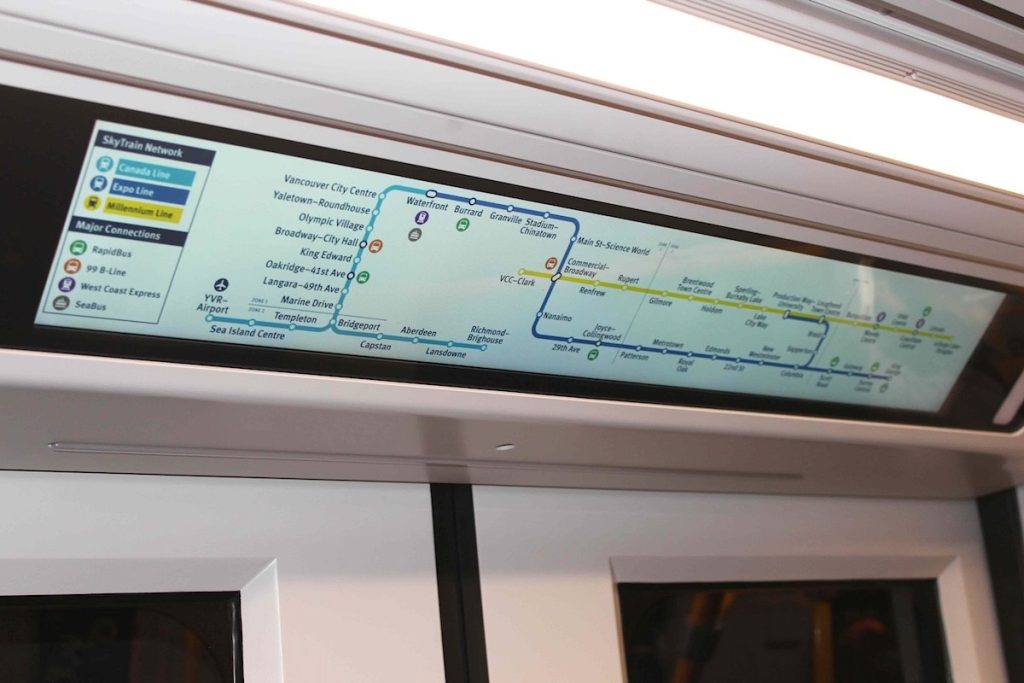
Metro stations and rail transit concourses typically operate in semi-indoor or controlled lighting environments, with high passenger density and long equipment operating hours. Display terminals in these scenarios should prioritize long-term stability, information readability, and system integration capability.
- Recommended display solutions: industrial-grade IPS LCD display terminals or embedded digital signage displays
- Key specifications: 700–1500 cd/m² brightness, Full HD or higher resolution, 178° ultra-wide viewing angle, 24/7 continuous operation capability
- Structural recommendations: metal housing, fanless thermal design, anti-glare protective glass, front maintenance or easy installation design
- System requirements: support for network-based content distribution, remote power control, device status monitoring, and centralized management platform integration
In environments with relatively stable ambient lighting such as metro platforms and station halls, excessively high brightness is not necessary. Compared to simply pursuing higher brightness, greater priority should be given to panel lifespan, thermal headroom, interface compatibility, and maintenance convenience.
- Outdoor Bus Stops: Sunlight Readability and Environmental Protection Are Critical
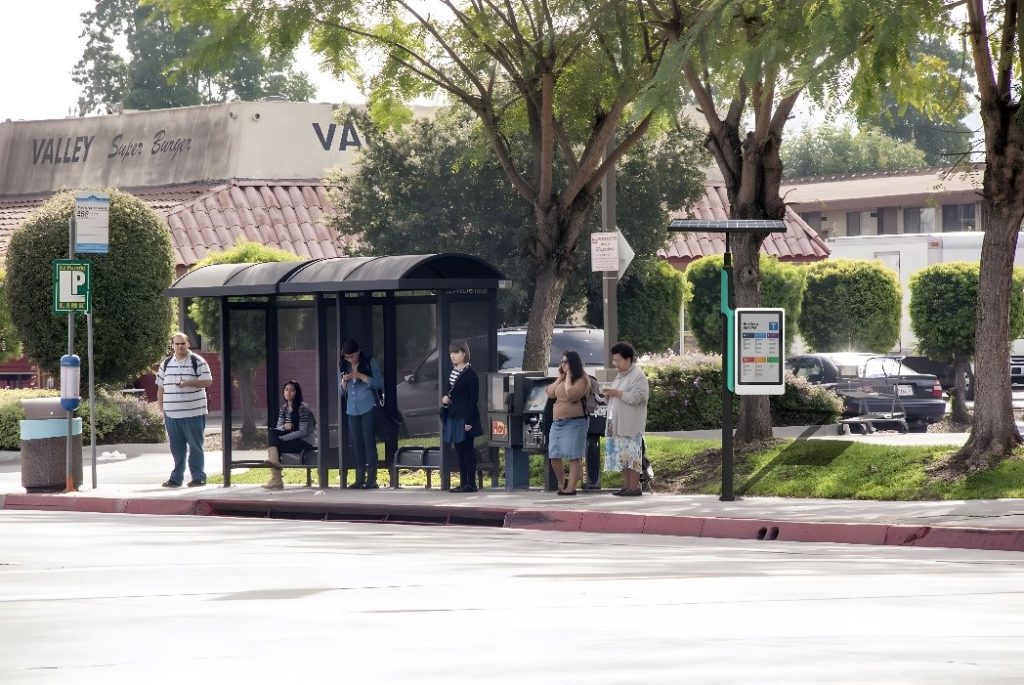
Outdoor bus stop signage, electronic bus shelters, and roadside information display screens are continuously exposed to harsh environmental conditions, including direct sunlight, rain, dust, temperature fluctuations, and unstable power supply conditions. Therefore, outdoor applications cannot rely solely on high-brightness panels; instead, a comprehensive evaluation of optical design, structural protection, power management, and thermal control is required.
- Brightness recommendations: for standard outdoor applications, 1500–3500 cd/m² depending on installation direction; in high-glare environments, ambient light sensors can be used for automatic brightness adjustment
- Protection recommendations: front panel or full enclosure should meet IP65 or higher standards, with special attention to sealing design, cable routing, and waterproof connectors
- Optical recommendations: anti-glare / anti-reflective cover glass, optical bonding, and UV protection are preferred to improve visibility under strong sunlight
- Thermal management recommendations: high-brightness LCDs should be combined with efficient heat dissipation structures, temperature control strategies, and anti-condensation design to avoid brightness degradation or black screen risks caused by overheating
- Low-power direction: for solar-powered or remote installations, semi-transmissive, reflective (cholesteric LCD) or other low-power display technologies should be evaluated
- Onboard Bus and Rail Transit: Focus on Vibration Resistance, Wide Voltage Input, and Embedded Platforms
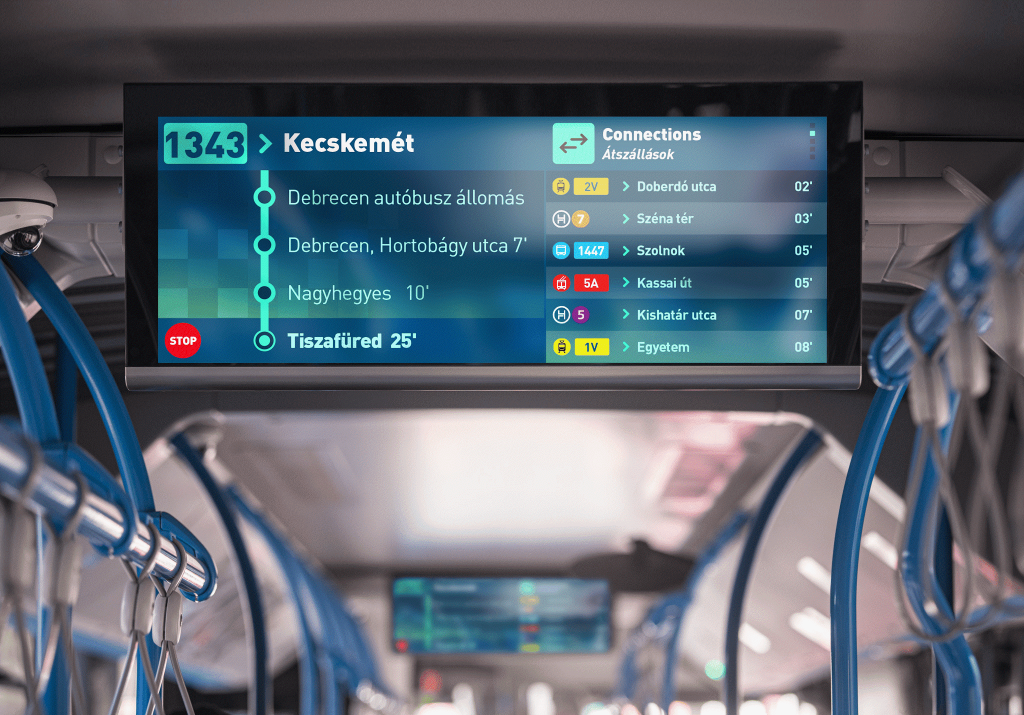
Displays installed inside buses, trains, trams, and other vehicles face more demanding conditions compared to fixed station equipment. These applications require compact structure design, strong vibration and shock resistance, and high adaptability to vehicle power systems. In addition, onboard display terminals are often integrated with vehicle control systems, passenger information systems (PIS), or media playback systems, making platform compatibility equally important.
- Structural design: compact metal housing, reinforced mounting methods, and vibration-resistant installation solutions
- Power input: DC12V, DC24V, or wide-voltage input options depending on vehicle system requirements, with surge protection and abnormal power-loss protection
- System platforms: Android, embedded Linux, or x86 platforms depending on project needs to enable software integration and remote management
- Application functions: next-stop information display, route guidance, advertising playback, driver assistance display, and passenger entertainment systems
- Airports and Integrated Transportation Hubs: Focus on Standalone LCD Information Terminals and Self-Service Systems
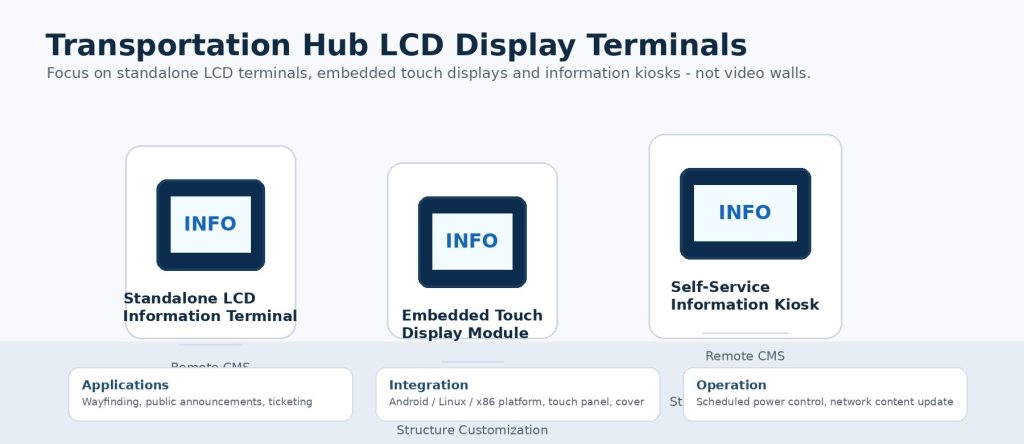
Airports, railway station halls, and intercity passenger terminals place strong demands on display systems, primarily for passenger guidance, service information delivery, self-service inquiry, and public announcements. For these applications, this section focuses on standalone LCD information terminals, embedded touch display modules, and all-in-one information kiosks—display solutions that align more closely with Techtion Smart’s product capabilities.
- Standalone information display terminals: suitable for schedule information, transfer guidance, public announcements, and advertising content
- Embedded display modules: suitable for self-service kiosks, ticketing machines, service terminals, and gate or cabinet integration
- Touch and structural customization: cover glass, touch solutions, interfaces, and mounting structures can be customized based on customer enclosure, installation method, and interaction requirements
- Remote operations and maintenance: support network-based content management, scheduled power control, device status monitoring, and software platform integration
- Recommended Selection Guidelines for Different Transportation Scenarios
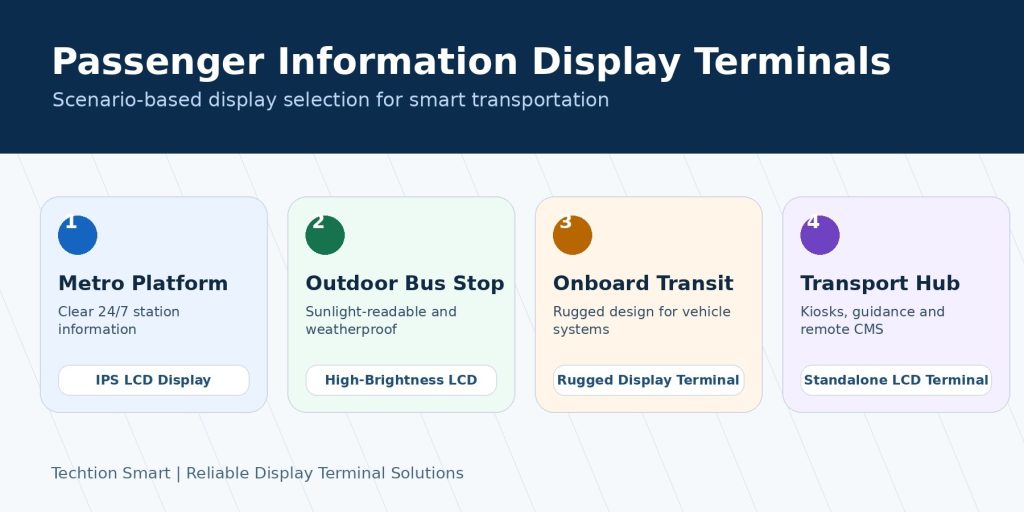
Application Scenario | Recommended Display Type | Key Selection Factors | Techtion Smart Support Direction |
Metro / Rail Platforms | Industrial-grade IPS LCD display | ·Readability, ·Wide viewing angle, ·24/7 operation, ·Centralized management | ·High-brightness / wide-view LCDs ·Metal housing ·Network media player integration |
Outdoor Bus Stops / Electronic Signage | High-brightness LCD or low-power reflective display solutions | ·Sunlight readability ·Waterproofing, ·Dust protection ·Thermal management ·Energy efficiency | ·High-brightness backlight ·Optical bonding ·IP protection ·Temperature control & low-power solutions |
Onboard Bus / Rail Transit | Rugged embedded display terminals | ·Vibration resistance ·Wide voltage input ·Compact Structure ·Platform Compatibility | ·Android / Linux / x86 platforms, ·Vehicle-grade mounting structures ·Customized interfaces |
Airports / Passenger Terminals / Railway Hubs | Standalone LCD information terminals / embedded display modules | ·Long-distance readability ·Touch interaction ·Remote maintenance ·Enclosure integration | ·Touch display modules ·Information kiosks ·Structural and interface customization |
- Conclusion: From “Screen Selection” to “System Solution Selection”
The value of transportation display systems lies not only in the screen itself, but in their ability to operate reliably in real-world environments over the long term. For system integrators, vehicle manufacturers, and transportation operators, an ideal display terminal must simultaneously meet requirements for environmental adaptability, structural integration, software platform compatibility, remote management, and long-term supply stability.
Techtion Smart specializes in LCD display terminal solutions for smart transportation, industrial, and outdoor applications. Based on project requirements, the company provides customized support ranging from display panels, touch cover glass, structural enclosures, and interface configurations to Android/x86 platform integration, helping customers build more reliable, energy-efficient, and easier-to-maintain passenger information systems across diverse transportation scenarios.
Previous Article
Microsoft Teams
WhatsApp
Email
Inquiry
WeChat
TOP