
How to Select the Right Enclosure Material for Industrial Display Terminals
Q: What enclosure materials do you use for your display terminals?
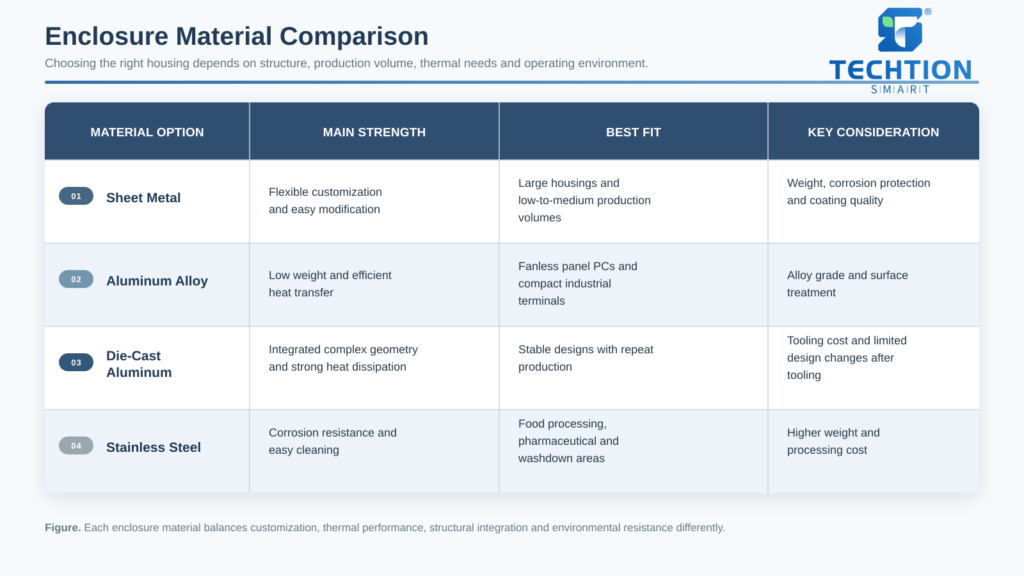
A: We do not use one enclosure material for every product. The right solution depends on the operating environment, structural requirements, production volume, thermal design and project budget. Common options include sheet metal, aluminum alloy, die cast components and stainless steel.
Materials and Manufacturing Processes Are Not the Same
Sheet metal and die casting describe manufacturing processes, while aluminum alloy, stainless steel and cold rolled steel describe materials. A sheet metal enclosure may be made from cold rolled steel, galvanized steel, aluminum or stainless steel. A die cast enclosure is commonly made from aluminum alloy.
Sheet Metal Enclosures
Sheet metal is widely used for industrial monitors, panel PCs and outdoor display terminals. The enclosure is formed through cutting, bending, welding and surface finishing. The structure can be modified relatively easily, which makes sheet metal suitable for large products, products with many interfaces and projects requiring low volume customization.
Cold rolled steel offers good structural strength and cost efficiency. Powder coating can improve corrosion resistance and create a consistent appearance. Its weight is generally higher than that of aluminum, so the mounting structure, transport requirements and overall handling weight should also be considered.
Aluminum Alloy Enclosures
Aluminum alloy combines relatively low weight with good thermal conductivity. It is often selected when heat dissipation, weight and appearance are important. In a fanless industrial panel PC, the aluminum rear housing may form part of the thermal path, transferring heat from the processor and internal components to the exterior surface.
Aluminum parts may be produced by CNC machining, extrusion or sheet metal forming, then finished by anodizing, sandblasting or coating. Aluminum alone does not guarantee corrosion resistance or ingress protection. The alloy grade, surface treatment, sealing method and installation environment must still be evaluated.
Die Cast Enclosures
Die cast components are typically made from aluminum alloy and formed in a dedicated mold. This process can integrate ribs, mounting bosses, thermal features and other complex geometry into one part while maintaining good dimensional consistency. It is well suited to designs that are stable and expected to enter repeat production.
The main tradeoff is the initial tooling investment. Later design changes may also require mold modification. Die casting may therefore be uneconomical for prototypes or highly customized low volume projects, but it can offer strong consistency and production efficiency for long term volume manufacturing.
Stainless Steel Enclosures
Stainless steel provides strong resistance to corrosion, cleaning and mechanical impact. It is commonly considered for food processing, pharmaceutical, chemical, marine, outdoor and washdown applications. Grade 304 is often suitable for general industrial and hygienic environments. Grade 316 may be evaluated where equipment is exposed to salt spray, coastal air or more aggressive corrosive media.
Stainless steel is heavier and usually more expensive to process than common steel or aluminum. Its thermal behavior must also be addressed separately, especially when the enclosure contains high power electronics or uses a fanless design.
Case Studies
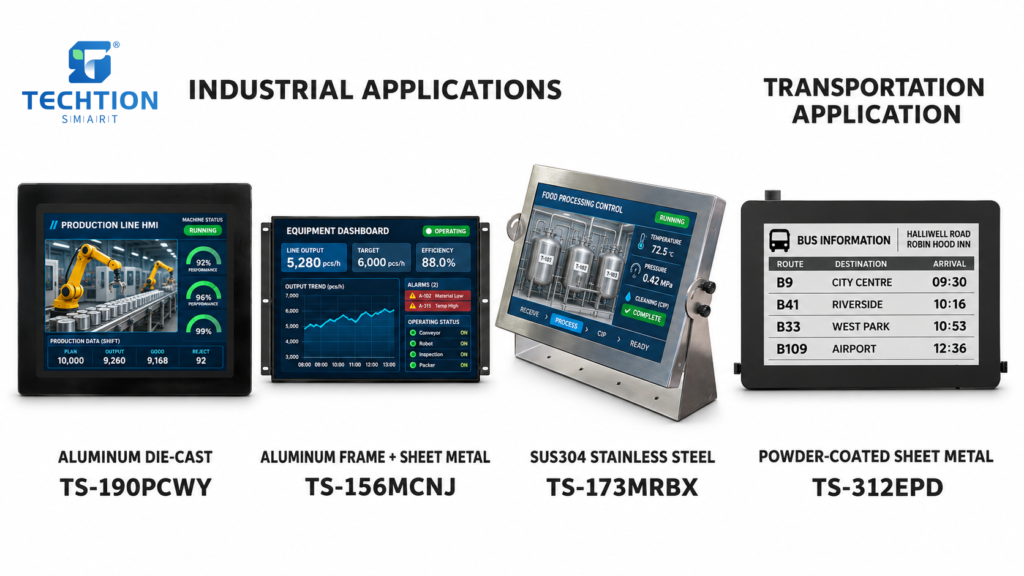
1. Industrial Panel PCs and Fully Enclosed Industrial Monitors: Die-Cast Aluminum Housings
Techtion Smart’s standard industrial panel PCs and industrial monitors—particularly medium- and small-sized, fanless, fully enclosed models—commonly use die-cast aluminum housings.
Aluminum alloy provides a good balance of heat dissipation, structural strength, and overall weight. The rear housing can also incorporate integrated cooling fins during the die-casting process, making this construction particularly suitable for industrial panel PCs equipped with x86 or Android motherboards.
Applications: industrial automation, robotic systems, production-line monitoring, and equipment HMIs.
2. Embedded and Open-Frame Industrial Monitors: Aluminum Frames and Galvanized-Steel Housings
Industrial monitors installed inside machines or equipment do not necessarily require a fully die-cast enclosure. A common construction consists of:
- An aluminum front frame for a clean appearance, installation accuracy, and front-panel strength;
- A galvanized sheet-metal rear housing for easier customization of interfaces, mounting holes, and installation brackets;
- A black powder-coated surface finish for added protection and a consistent appearance.
Applications: control cabinets, inspection equipment, production data dashboards, and self-service equipment.
3. Rugged and Hygienic-Grade Industrial Products: SUS304 Stainless Steel
SUS304 stainless steel is commonly used for products requiring corrosion resistance, easy cleaning, washdown protection, or higher hygiene standards, including:
- Food-processing equipment;
- Pharmaceutical production lines;
- Water-treatment equipment;
- Chemical and marine environments;
- Meat-processing and washdown areas.
Applications: food production lines, cleanrooms, pharmaceutical equipment, and corrosive outdoor environments.
4. E-Paper, ChLCD, and Transportation Displays: Powder-Coated Sheet-Metal Housings
Techtion Smart’s large-format e-paper displays, ChLCD terminals, transportation bar displays, and digital-signage products commonly use powder-coated sheet-metal housings.
These products are generally larger and need sufficient internal space for batteries, motherboards, connectors, thermal-management components, and mounting hardware. Sheet metal makes it easier to customize the enclosure dimensions, material thickness, openings, and wall-mounting structures, making it well suited to the requirements of customized transportation projects.
The same type of construction is also commonly used for:
- TS-280EPD e-paper terminal;
- TS-286THD stretched bar display;
- TS-366THD high-brightness display with local dimming;
- TS-315PHDC large-format ChLCD terminal.
What Else Should Be Considered
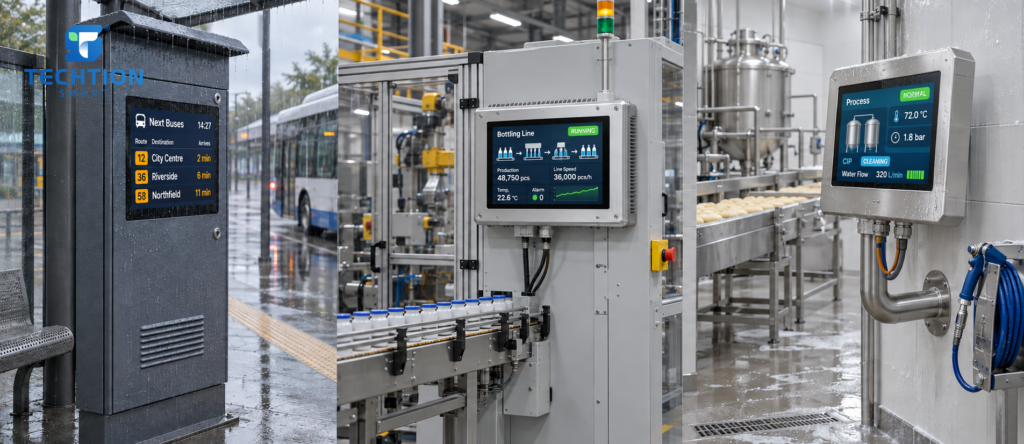
Enclosure material is only one part of the complete product design. The following questions should be reviewed before a material and process are selected:
- Will the terminal operate indoors or outdoors
- Will it be exposed to rain, salt spray, oil, chemicals or cleaning agents
- What are the product dimensions, weight limits and mounting method
- Does the system require fanless heat dissipation
- What IP rating and impact resistance are required
- Is the project a prototype, a customized low volume order or long term production
- What appearance, surface finish and budget targets must be met
Does Stainless Steel Automatically Mean IP65
No. A stainless steel housing does not automatically make an outdoor terminal IP65. Ingress protection depends on the complete enclosure system, including the cover glass, gasket or sealing adhesive, housing joints, connectors, cable outlets, ventilation structure and assembly process. The final protection level must be verified on the assembled product in its intended installation condition.
The Right Material Depends on the Application
There is no single best enclosure material for every display terminal. The most suitable solution is the one that balances environmental reliability, structural performance, manufacturability, production volume and cost.
Techtion Smart evaluates sheet metal, aluminum alloy, die cast and stainless steel options according to each product and application rather than applying one construction to every project.
 Previous Article

 Microsoft Teams
 WhatsApp
 Email
 Inquiry
 WeChat

 TOP